Improving Productivity and Competitiveness
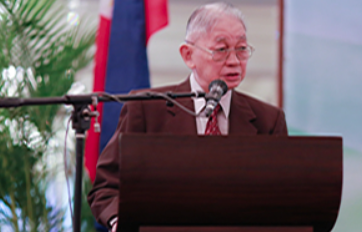
Mr. Meneleo Carlos, Jr., president of the Federation of Philippine Industries, recommended various measures to fast track the economic integration of the ASEAN region.
It is the vision of ASEAN established in 1967 to accelerate economic integration in order to significantly improve the productivity and competitiveness of regional industries and sector, attraction of ASEAN to external suppliers and investors, and hence the inclusive development, dynamism and poverty reduction of the regional economies.
Among his recommendations were for enhanced planning to be able to identify a country’s need to survive and grow, better use of ASEAN’s mineral, forest, marine and palm oil resources to build wealth and create value added products, harmonization of incentives for investments, tariff reduction to get rid of monopoly, and greater appetite for competition.
Mr. Carlos shared his perspectives as one of the “session panelists on “Private Sector’s Emerging Role in ASEAN Economic Integration,” featured at the Consultation and Information Dissemination on regional Trade Agreements and Free trade Agreements held at the Bayview Hotel Manila on 16 April 2008. The workshop was organized by the Philippine Chamber of Commerce and Industry, Universal Access to Competitiveness and Trade, Philippine Exporters Confederation and the Partnership and Advocacy for Competitiveness and Trade.
The one-day activity aimed to strengthen private sector’s knowledge of the different trade agreements and enable them to better understand the benefits and challenges brought about by trade liberalization.
In his brief presentation, Mr. Carlos said ASEAN needed to understand and adopt lessons learned from China, which many years back planned well to address the energy shortage. He cited China’s various agreements with countries from Africa and others for this purpose. He also said that China’s long-term planning provided stability to the nation without going overboard in responding to the rice crisis.
Mr. Carlos said, “many things have overtaken us. What should we do as the world is moving towards a supply crunch? Some 2.4 billion people are going into mainstream; the demand is tremendous.” He recommended that the region harness its tremendous mineral, forest, marine and palm oil resources to create wealth and value added products.
In the manufacturing sector, he called for reduced tariffs. “High tariffs create monopoly. We must introduce more competition, “Mr. Carlos pointed out.
“We need to talk to our ASEAN brothers to harmonize incentives for foreign investments. To what extent should we provide incentives to investors? We need to do a lot of catching up such as liberalizing our ports and airports. Let’s do this in a gradual basis,” Mr. Carlos added.
He said that the region lacks appetite for competition. “This needs to be wetted,” he noted.
The end goal of economic integration as espoused in the ASEAN Vision 2020 is to establish ASEAN as a single market and production base that allows for the free flow of goods, services, investment, capital and skilled labor, with a highly competitive economic region, a region of equitable economic development and fully integrated into the global economy.
Senior Undersecretary Thomas G. Aquino of the Department of Trade and Industry was the keynote speaker at the workshop. He spoke of the strategies and lessons learned by the Philippines from various negotiations on multilateral and bilateral trade agreements.
Mr. Aquino said there was a need for improved administrative mechanism for negotiations, for transparency, and for balancing market access objectives with internal capacities.
He called for enhanced public-private sector partnership in exploiting the challenges and benefits derived from trade agreements.